
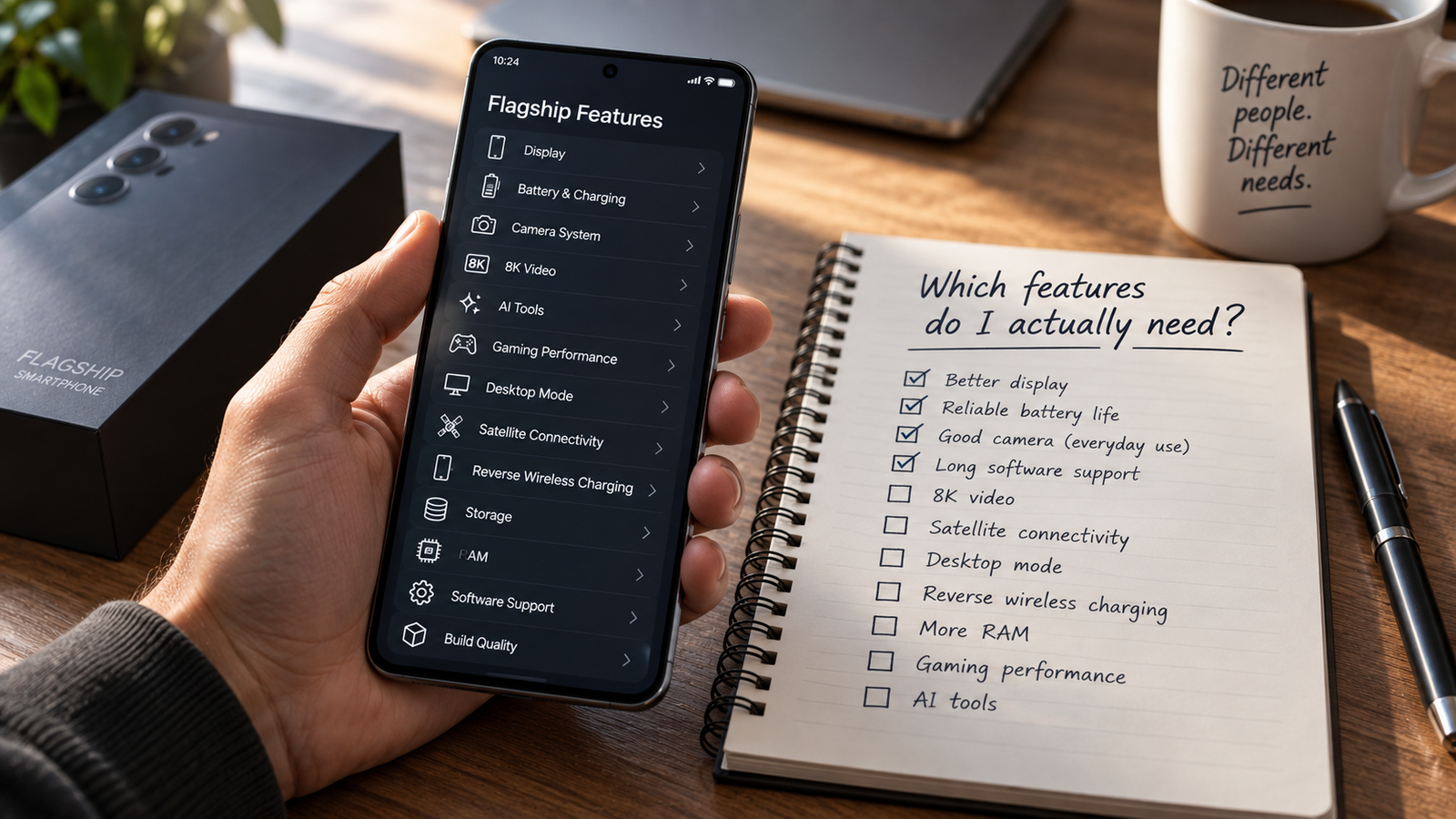
Buy a flagship smartphone today and you’re buying far more than a faster processor and a better camera.
You may also be paying for 8K video recording, RAW photography, advanced AI tools, desktop modes, extreme zoom, satellite connectivity, reverse wireless charging, professional video controls and dozens of smaller features hidden throughout the software.
Some of them can genuinely transform the way you use your phone.
Others may remain untouched for years.
The difficult part is that both types of features often appear next to each other on the same specification sheet.
So before spending significantly more on a flagship device, there is a more useful question than asking which phone has the longest feature list:
Which flagship smartphone features do you actually need?
Techrow.gr examines which premium smartphone features can genuinely improve everyday use, which become valuable only for specific users and which should not be the main reason you spend more on your next phone.
Start with what you actually do on your smartphone
Before comparing processors, megapixels or AI tools, look at how you currently use your phone.
Do you take hundreds of photos?
Do you record video regularly?
Do you play demanding games?
Do you keep a smartphone for four or five years?
Do you spend most of the day away from a charger?
Do you use your phone professionally?
Your answers matter far more than the number of features printed on the product page.
A creator and someone who mostly uses WhatsApp, Instagram, maps and Spotify can buy the same €1,000 smartphone, but they are not buying it for the same reasons.
This is why there is no universal list of flagship features that everybody needs.
The goal is not to find the phone that can do the most.
It is to find the phone that does your most important things particularly well.
A better display is something almost everyone can appreciate
Of all the improvements found in premium smartphones, the display is one of the easiest to benefit from every day.
You don’t need to be an enthusiast to appreciate a screen that remains readable outdoors, offers smooth scrolling, responds accurately to touch and maintains good color reproduction across different brightness levels.
High refresh rates are now common beyond the flagship category, so simply seeing “120Hz” on a specification sheet is no longer enough to establish that one display is better than another.
Peak brightness, automatic brightness behavior, minimum brightness at night, touch responsiveness, viewing angles and overall calibration can make a substantial difference in everyday use.
If you spend several hours a day looking at your smartphone, display quality is rarely a wasted investment.
Unlike many specialized features, you don’t need to remember to activate it.
You experience it every time you unlock the phone.
Long software support matters more than many spectacular features
Software support isn’t particularly exciting in a launch presentation.
There is no dramatic demonstration and no impressive camera sample to share on social media.
But if you plan to keep your smartphone for several years, it can be one of the most valuable premium features available.
Long-term operating-system and security updates can extend the useful life of a device, maintain compatibility with newer applications and reduce the pressure to upgrade simply because the software has been left behind.
This becomes particularly important as flagship smartphones become more expensive.
If you’re paying premium money, the phone should ideally remain properly supported for a meaningful portion of the time you intend to own it.
For long-term buyers, several years of reliable software support can matter far more than a camera mode they may use twice.
Battery life is more useful than a larger number on the spec sheet
Battery specifications appear straightforward.
One phone has 5,000mAh.
Another has 4,700mAh.
So the first must last longer.
Unfortunately, real-world battery life is considerably more complicated.
Display efficiency, processor behavior, modem performance, software optimization, background activity and the way the phone manages power all influence how long it lasts.
This means battery capacity should be treated as part of the picture rather than the final answer.
What matters is whether the phone comfortably survives your normal day.
A flagship that consistently reaches bedtime with power remaining may provide more practical value than a model with numerous advanced features but unpredictable endurance.
For many buyers, battery reliability is one of the best reasons to choose one device over another.
Fast charging matters differently depending on your routine
Charging speed is another feature that can be extremely useful for one person and much less important for another.
If you charge overnight and your phone reliably lasts the entire day, extremely fast charging may rarely change your routine.
If you travel frequently, work long shifts or regularly discover that your battery is low shortly before leaving home, rapid charging can be transformative.
The practical question isn’t simply:
“Which phone charges fastest?”
It is:
“How often would faster charging actually solve a problem for me?”
Charging is a perfect example of why feature value depends on lifestyle.
A capability doesn’t need to be universally important to be worth paying for. It needs to solve a recurring problem for you.
Camera quality matters more than megapixels
Flagship smartphone marketing loves camera numbers.
50MP.
108MP.
200MP.
But megapixels alone tell you surprisingly little about the final photographic experience.
Sensor size, lens quality, stabilization, image processing, autofocus, HDR performance and low-light behavior can all matter more than the headline resolution.
For most users, the most useful camera advantage is consistency.
Can you take the phone out of your pocket, press the shutter and reliably get a good photograph?
Does it handle moving subjects well?
Are skin tones natural?
Does the camera remain dependable indoors and at night?
Does switching between lenses produce dramatically different colors?
These questions usually matter more than the largest number on the box.
A high-resolution sensor can be useful, but it should not automatically become the reason you choose one flagship over another.
A good telephoto camera can be genuinely useful
Unlike some camera features that mainly create impressive demonstrations, a good telephoto lens can meaningfully expand what you can photograph.
Travel, concerts, architecture, portraits, pets and distant details can all benefit from real optical reach.
The important word, however, is good.
A phone advertising enormous maximum zoom doesn’t necessarily produce useful results at that maximum level. Digital enlargement can create spectacular marketing examples without being something you would regularly use.
Instead of focusing on whether a phone offers 30x, 50x or 100x zoom, consider how good the camera looks at the ranges you’re likely to use frequently.
A high-quality 3x or 5x telephoto camera may be far more valuable than an extreme zoom number that exists mainly at the edge of the device’s capabilities.
Ultra-wide cameras are useful, but quality varies enormously
The ultra-wide camera is easy to overlook because almost every premium smartphone now includes one.
That doesn’t mean they are all equally useful.
A good ultra-wide camera can be valuable for landscapes, architecture, interiors and situations where you simply cannot move farther away from the subject.
But secondary cameras are also one of the areas where manufacturers sometimes make compromises.
Resolution alone doesn’t guarantee quality. Sharpness at the edges, autofocus, low-light performance and color consistency with the main camera all matter.
If photography is important to you, don’t evaluate only the main sensor.
A flagship camera system should ideally feel like a system, not one excellent camera surrounded by weaker ones.
RAW photography is valuable — if you actually edit photos
RAW support is frequently presented as a professional advantage, and for the right user it genuinely is.
RAW files preserve much more image information and provide considerably greater flexibility during editing. Photographers can recover highlights, adjust shadows, modify white balance and process an image according to their own preferences.
But there is a trade-off.
RAW files are larger, require editing and often look less immediately attractive than the phone’s automatically processed JPEG or HEIF images.
If your normal photography workflow is:
take photo → share photo,
RAW may add almost nothing to your experience.
If you regularly edit photographs in Lightroom or similar software, however, it can become one of the most useful advanced camera capabilities available.
This is exactly what a good flagship feature should be: optional for most people, powerful for those who genuinely need it.
Do you really need 8K video?
For most smartphone buyers, 8K video should not be a major purchase criterion.
It demonstrates what modern camera hardware and processors are capable of doing, but the practical advantages are limited for typical users.
8K footage consumes significant storage, requires more processing power and creates larger files that are more demanding to edit and archive.
Meanwhile, high-quality 4K recording is already more than sufficient for most personal videos, social-media content and even many professional applications.
There are specialized workflows where 8K can be valuable. It gives creators additional resolution for cropping, reframing and post-production.
But unless you already understand why you need 8K, there is a good chance that you don’t need to pay extra specifically to get it.
That is a useful rule for many advanced smartphone features.
If you need it professionally, you probably already know why.
Professional video controls matter enormously to a small audience
LOG recording, manual shutter controls, external microphone support, advanced stabilization options and professional codecs can make modern smartphones surprisingly capable video-production tools.
For creators, journalists and small production teams, these features can be extremely valuable.
A smartphone can become a secondary camera, an emergency production device or even the main camera for certain types of content.
For most users, however, automatic video mode remains more practical.
This doesn’t make professional controls unnecessary.
It simply means they belong in the category of features whose value depends heavily on the person buying the phone.
A creator should actively compare them.
Everyone else can safely treat them as a bonus.
Performance matters, but flagship performance can exceed your needs
Modern flagship processors are extraordinarily powerful.
They can handle demanding games, advanced image processing, high-resolution video, AI workloads and heavy multitasking.
The important question is whether you actually need that level of performance.
For messaging, browsing, social media, streaming and everyday applications, capable mid-range processors can already provide very good experiences.
Flagship performance becomes more relevant if you play demanding games, edit video, use emulators, perform heavier creative tasks or simply want maximum performance headroom for several years.
But even then, processor benchmarks do not tell the entire story.
Thermal management matters.
A phone that performs extremely well for two minutes and then throttles heavily may be less useful for gaming than a device with slightly lower peak performance but better sustained behavior.
Gamers should look beyond the processor name
If mobile gaming is important, the processor is only one part of the experience.
Cooling, touch response, display behavior, battery endurance, speaker quality and software gaming tools can all affect how enjoyable the device is during longer sessions.
A powerful chipset inside a thin phone with poor thermal management may struggle to maintain performance.
Likewise, extremely high refresh rates provide limited value if the games you actually play cannot take advantage of them.
Gamers should therefore think in terms of the complete gaming experience rather than buying the highest benchmark score available.
Sustained performance often matters more than peak performance.
More RAM isn’t automatically better
RAM is another specification that is easy to compare.
16GB appears better than 12GB.
24GB appears better than 16GB.
But smartphone memory management depends heavily on software.
A well-optimized device with 12GB of RAM can deliver a better multitasking experience than a poorly optimized phone with a larger number printed on its specification sheet.
For most users, once a smartphone has enough memory to comfortably handle their applications and multitasking habits, additional RAM can produce diminishing practical returns.
Heavy users, gamers and people who keep many demanding applications active may benefit from more.
But buying the largest RAM number available simply for future-proofing isn’t always necessary.
Storage is one specification where paying more can make sense
Storage capacity is different because running out of it creates an immediate and frustrating limitation.
Photos, videos, games, offline music and applications can consume space surprisingly quickly, especially if you keep a smartphone for several years.
Unlike cloud storage, local storage is always available and doesn’t require a network connection.
Creators recording large video files have particularly demanding requirements.
For a light user, 128GB may still be perfectly adequate.
For someone who stores large photo libraries, downloads media or keeps several large games installed, 256GB or more can be a very sensible upgrade.
The right amount isn’t determined by the flagship category.
It is determined by how much storage you already use and how long you plan to keep the device.
AI features should be judged individually
AI has become one of the biggest selling points in premium smartphones.
But “AI features” is now such a broad category that treating them as one feature is almost meaningless.
Automatic transcription can be extremely useful.
Live translation may be invaluable to travelers or multilingual professionals.
AI photo editing can save considerable time.
Writing tools may help some users while being completely irrelevant to others.
The key is to avoid buying the label AI and instead evaluate the individual tools underneath it.
Ask whether the feature solves something you currently spend time doing.
If the answer is yes, it may have real value.
If the demonstration simply looks impressive but you cannot imagine when you would use it, treat it accordingly.
On-device AI can matter for more than novelty
There is, however, another consideration.
Some AI tasks can run directly on the smartphone rather than depending entirely on cloud processing.
This can provide advantages in speed, privacy and offline availability depending on the implementation.
For users who regularly rely on transcription, translation or image-processing tools, dedicated AI hardware may therefore become increasingly relevant over the lifetime of the phone.
But this remains an evolving area.
Buying a smartphone exclusively because it promises vague future AI capabilities is risky.
Buy for what the device demonstrably does today, and treat future improvements as a bonus rather than a guarantee.
Desktop modes are brilliant — for the people who use them
Some flagship smartphones can connect to an external display and provide a desktop-like interface.
For certain professionals, this can be extremely useful. A phone can function as a lightweight workstation during travel, presentations or emergency situations.
For the average buyer, the feature may never be opened.
Whether you need it therefore comes down to a very concrete question:
Can you describe a realistic situation where you would connect your phone to a monitor?
If the answer is yes, investigate the implementation carefully.
If the answer is no, don’t allow desktop mode to influence the purchase simply because it appears impressive in a feature comparison.
Reverse wireless charging is convenient, not essential
Reverse wireless charging allows the smartphone to provide power to another compatible device, often earbuds, a smartwatch or another phone.
It’s clever and occasionally very useful.
It can rescue wireless earbuds during travel or provide enough emergency power to another device to get through the day.
But it is relatively inefficient and unlikely to replace a proper charger or power bank.
For most buyers, reverse wireless charging belongs in the category of nice-to-have features.
If two otherwise equal phones offer it, excellent.
It usually shouldn’t justify choosing a much more expensive device on its own.
Satellite connectivity is different from most rarely used features
Satellite connectivity creates an interesting exception to the idea that frequently used features are automatically more valuable.
Ideally, emergency satellite communication is something you never need.
That doesn’t make it useless.
For hikers, travelers, people who frequently work in remote areas or anyone spending significant time beyond reliable cellular coverage, it can provide genuine additional security.
Its value is therefore closer to an emergency tool than an everyday convenience.
This demonstrates why usage frequency alone is a poor way to evaluate features.
Some capabilities are valuable precisely because they are available during the rare moment when you really need them.
Premium materials matter if you care about how the phone feels
Flagship pricing isn’t only about functions.
Build quality, materials, haptics, button feel, speaker quality and overall refinement can influence the experience every single day.
These elements are difficult to compare through a specification table because there is no simple numerical measurement for how satisfying a vibration motor feels or how well-balanced a phone sits in the hand.
Yet they can contribute enormously to whether a device actually feels worth its premium price.
A smartphone is something you physically interact with dozens or hundreds of times each day.
That means seemingly small hardware details can ultimately matter more than a specialized feature buried inside a menu.
Good haptics are underrated
Haptic feedback is one of the clearest examples.
Almost every smartphone can vibrate.
That doesn’t mean every smartphone provides the same experience.
Precise, controlled feedback can make typing, gestures, navigation and system interactions feel more deliberate. Poor haptics can make an otherwise capable device feel noticeably cheaper.
You will rarely see haptic quality dominating an advertising campaign.
But you may experience it hundreds of times every day.
This is exactly why buying decisions shouldn’t be based exclusively on headline specifications.
Some of the best premium features are the least marketable ones.
Better speakers and microphones affect more users than expected
Smartphones have become televisions, music players, video-call devices, voice recorders and content-creation tools.
That makes audio quality increasingly important.
Good stereo speakers can improve videos, games and podcasts. Better microphones can improve calls, voice notes and recorded video without requiring any additional effort from the user.
These aren’t glamorous features.
They are also difficult to summarize with a single specification.
But because they affect many common tasks, they often create more day-to-day value than niche headline capabilities.
Reliable biometrics are worth more than they sound
Fingerprint sensors and face-unlock systems are another example of technology that becomes almost invisible when implemented well.
You may unlock your phone dozens of times every day.
If authentication works quickly and consistently, you barely think about it.
If it fails frequently, it becomes irritating almost immediately.
The same principle applies to proximity sensors, automatic brightness, GPS reliability and connectivity.
Premium experience is often about reducing small points of friction rather than adding spectacular capabilities.
You notice the best implementations precisely because you stop having to think about them.
Don’t pay for a feature just because it looks impressive in a demo
This is one of the most important rules when buying a flagship smartphone.
Product demonstrations are designed to show technology under conditions where its advantage is obvious.
A 100x zoom demonstration focuses on an extremely distant object.
An AI editor removes something dramatically from a photograph.
8K footage is displayed on ideal hardware.
Desktop mode appears on a large monitor.
The demonstration proves the capability works.
It does not prove that the capability belongs in your life.
Before allowing a feature to influence your purchase, translate the demonstration into a realistic scenario:
When would I personally use this?
If you cannot answer, its value to you may be considerably lower than its marketing visibility suggests.
Why do flagships include so many features in the first place?
Of course, there is a reason these capabilities keep appearing even when only some buyers actively use them.
Modern flagship smartphones are designed for extremely broad audiences. The same model may need to attract creators, professionals, gamers, photographers and ordinary consumers simultaneously.
Advanced hardware also gives manufacturers opportunities to experiment with capabilities that may eventually become mainstream.
Athens Pulse explores this broader question in “Why Do Expensive Smartphones Still Come With Features Most People Never Use?”, looking at why flagship devices continue accumulating increasingly specialized capabilities even when many owners may barely explore them.
A feature being irrelevant to you does not mean it is irrelevant to everybody.
The challenge is separating the manufacturer’s complete list of possibilities from your own list of priorities.
Features can sell even when you rarely use them
There is also a marketing reason that advanced capabilities remain so visible.
A feature can influence the buying decision before the customer ever uses it. Large camera numbers, advanced AI tools, unusual productivity modes and professional controls all help differentiate products in advertising and comparison tables.
They make the device appear more capable and can help justify premium pricing.
Targeted.gr examines this side of the discussion in “Why Smartphone Features Sell Even When Most Buyers Rarely Use Them” exploring how specifications, future possibilities and perceived value can make a capability commercially powerful even when everyday usage remains limited.
This is why consumers need to distinguish between a feature’s ability to sell a phone and its ability to improve their experience after buying it.
Those are not always the same thing.
More features can eventually create more complexity than value
There is another side to the feature race.
Every capability manufacturers add needs to be designed, maintained, explained and integrated into the wider product. Enough additions can make software more complicated and products increasingly difficult to navigate.
Market Insiders examines this business problem in “The Feature Creep Problem: When More Product Features Stop Creating Value” looking at what happens when additional functionality begins increasing complexity faster than customer value.
From the consumer perspective, that creates another reason not to judge a smartphone by the length of its feature list.
More isn’t automatically better.
Sometimes a cleaner, more consistent implementation of fewer features produces a better device.
So which flagship features are worth paying for?
For most users, the strongest reasons to pay more are usually the features and qualities they will experience repeatedly.
A high-quality display, dependable battery life, long software support, strong camera consistency, sufficient storage, reliable connectivity, good speakers, microphones and biometrics can all affect everyday ownership.
After that, priorities become more personal.
A photographer may place enormous value on RAW support and telephoto quality.
A creator may care about LOG video, external microphones and storage.
A gamer may prioritize cooling and sustained performance.
A traveler may care about satellite communication, battery endurance and connectivity.
A business user may benefit from security features, long software support and desktop functionality.
The important part is that each premium capability has a specific reason to exist in your buying decision.
Build your own feature hierarchy before comparing phones
One useful approach is to divide features into three categories before shopping.
First are the must-haves: capabilities you know you will use regularly or that solve an important problem.
Second are the nice-to-haves: features you would appreciate but would not pay a large premium to obtain.
Third are the interesting extras: capabilities that look impressive but have no clear role in your current routine.
This simple exercise can make smartphone comparisons much easier.
Instead of being distracted by whichever manufacturer presents the longest list, you can judge each device against your own priorities.
That turns the specification sheet from a marketing document into a useful decision-making tool.
The best flagship is the one whose premium features you actually use
Flagship smartphones are extraordinary precisely because they can do so many things.
That versatility is part of their appeal.
But buying one shouldn’t become an exercise in collecting the largest possible number of capabilities.
You don’t need every professional camera mode simply because the phone offers them. You don’t need the fastest processor if your applications never challenge it. You don’t need 8K video because 8K appears higher on a specification sheet than 4K.
At the same time, a feature used by only a minority of people can be absolutely worth paying for if you are part of that minority.
That is the distinction that matters.
A good buying decision doesn’t ask:
“Which flagship smartphone has the most features?”
It asks:
“Which flagship smartphone spends its premium budget on the things I actually care about?”
Once you know the answer, dozens of impressive specifications become much easier to ignore.
Frequently Asked Questions
Which flagship smartphone features are worth paying for?
For most users, high-quality displays, dependable battery life, long software support, strong camera performance, sufficient storage, reliable biometrics and good speakers provide consistent everyday value. More specialized features depend heavily on individual usage.
Do I need 8K video on my smartphone?
Most users do not. High-quality 4K video is sufficient for everyday recording, social media and many professional workflows. 8K becomes more useful for specialized production work involving cropping or reframing.
Is a 200MP smartphone camera better than a 50MP camera?
Not necessarily. Megapixel count is only one part of camera performance. Sensor size, lenses, processing, autofocus, stabilization and low-light performance can have a greater impact on actual image quality.
How much RAM does a flagship smartphone need?
The answer depends on the operating system, software optimization and your usage. Heavy multitasking and gaming can benefit from more RAM, but beyond a certain point additional memory may provide little noticeable improvement for typical users.
Are smartphone AI features worth paying extra for?
Some can be, particularly if you regularly use tools such as transcription, translation or advanced photo editing. The value depends on the individual feature rather than the general “AI” label.
Is satellite connectivity useful on a smartphone?
It can be extremely useful for people who travel, hike or work in areas without reliable cellular coverage. Although it may rarely be used, emergency connectivity can still provide significant value in the situations where it is needed.
Should I choose the phone with the most features?
No. A longer feature list does not automatically mean a better smartphone. Prioritize the capabilities you will use regularly and the fundamental qualities that affect everyday experience.