
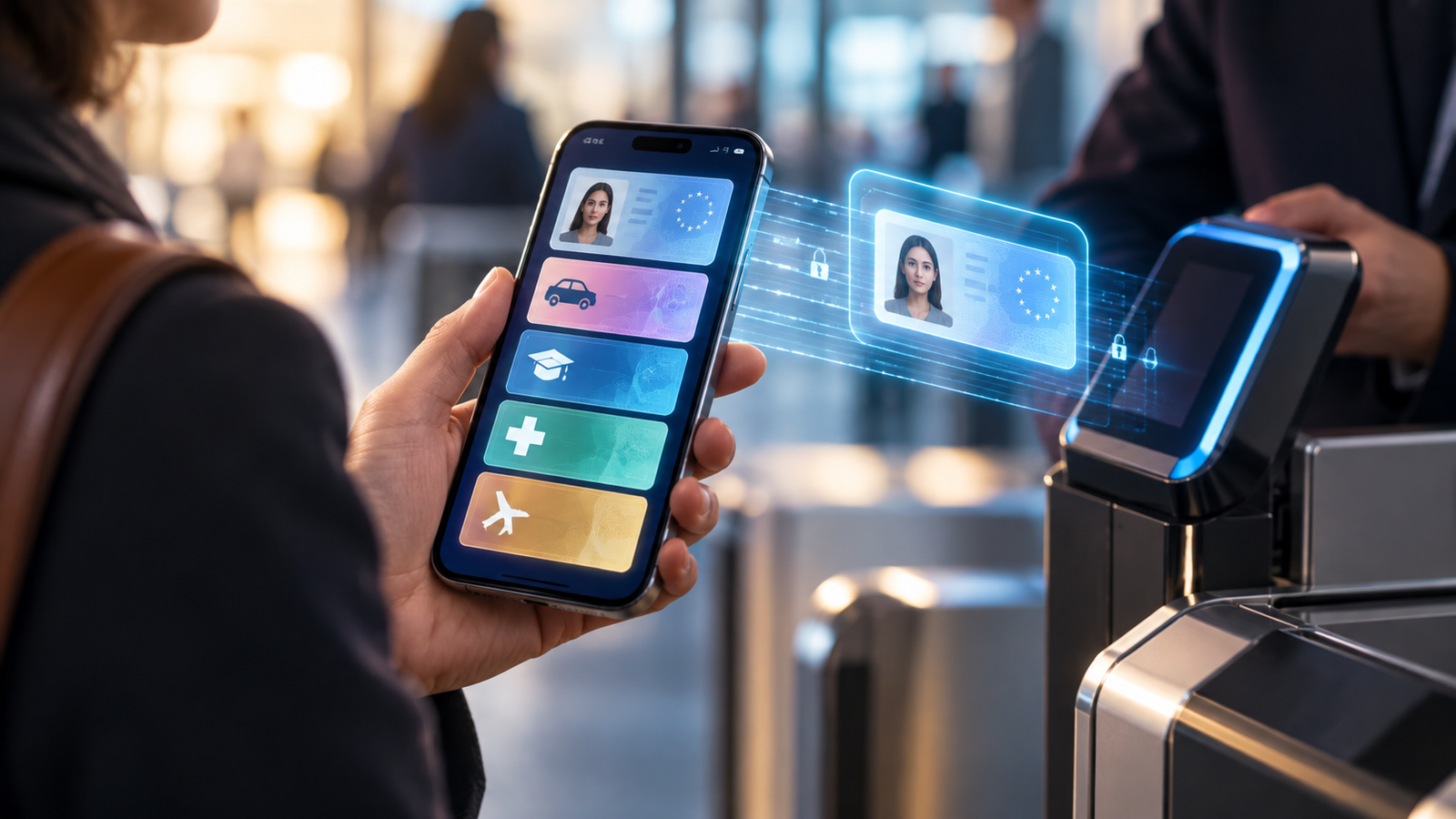
A digital wallet on your phone is already a familiar idea. Many people use one for payment cards, boarding passes, tickets or digital keys.
The EU Digital Identity Wallet takes the same basic concept in a different direction. Instead of focusing mainly on things you can pay with or scan at a gate, it is designed to hold verified information about you: your identity, certain official credentials and digital documents that can be presented when a service needs them.
That could include a mobile driving licence, educational qualifications or other verified attributes, depending on what is issued and supported in each country. The wallet can also be used to identify yourself to public and private services, share selected information and electronically sign documents.
The important point is that this is not simply a folder containing photographs of your documents. The credentials inside the wallet are designed to be digitally verifiable.
So what will actually happen on the phone?
First, there will not be one identical EU wallet app for everyone
Despite the name, the European Union is not preparing one universal app that every European will download from the App Store or Google Play.
Each Member State must provide at least one compliant wallet built according to common European rules and technical specifications. The aim is for those different national implementations to work with issuers and services across Europe rather than becoming isolated national systems.
That also means screenshots or demonstrations of the EU Digital Identity Wallet should not necessarily be interpreted as the final interface everyone will receive.
The Commission itself notes that its illustrative wallet screens are examples rather than representations of exactly how the wallets made available by Member States will look.
So the functionality is being standardised much more tightly than the visual design.
What can the EU Digital Identity Wallet actually contain?
The wallet is designed to handle two broad types of information.
The first is personal identification data, which can be used to establish who you are.
The second is digital documents and credentials — often described within the framework as attestations of attributes — that prove a particular fact about you.
The Commission gives examples including mobile driving licences, educational credentials and medical prescriptions, while its wider list of use cases includes banking, employment, university enrolment, travel and age verification.
That does not mean every wallet will immediately contain every one of those items.
A credential has to be issued by an appropriate authority or trusted organisation before you can use it.
The wallet provides the container and the technical mechanism. It does not automatically create official documents that have never been issued to you.
A digital credential is not the same thing as a PDF or photo
This is probably the most important concept to understand.
Suppose you photograph your driving licence and store the image on your phone. You now have a digital copy, but another organisation has limited ability to determine whether that image is genuine, current or modified.
A wallet credential works differently.
The EU framework is being designed so wallets can securely store, present and verify personal identification data and digital documents using common schemas, formats and trust mechanisms.
The value lies in the information being cryptographically and institutionally verifiable, not simply visible on a screen.
The difference is similar to the difference between showing someone a screenshot of a boarding pass and presenting an actual scannable boarding credential recognised by the airline’s system.
Both appear on your phone.
Only one participates directly in a trusted digital process.
How does a credential get into the wallet?
The wallet does not invent credentials itself.
An authorised issuer provides them.
That issuer could be a government authority, educational institution or another trusted organisation capable of issuing the relevant digital information. The EU’s technical model explicitly separates wallet providers, credential issuers and the service providers that later request information from the wallet.
Imagine a university issuing your diploma.
Instead of receiving only a paper certificate or downloadable PDF, the university could issue a compatible digital credential that you add to your wallet. When you later apply for a job, you could present that credential to an employer capable of verifying it.
The same basic model can apply to other types of documents.
Issuer → wallet → service requesting verification.
The user sits in the middle and controls the presentation of the credential.
What happens when a website asks for your identity?
This is where the wallet should start feeling practical.
Imagine you open a service that requires verified identity. Rather than creating another verification profile, photographing your ID and uploading the image, the service could request the relevant information from your wallet.
You would receive a request explaining what information the service wants. You then approve the presentation through the wallet, and the service receives the information necessary for that interaction.
The Commission describes the wallets as allowing users to identify themselves to public and private online services and share information with only a few interactions on their phone.
The precise interface will depend on the national wallet and service.
But the basic principle is much closer to approving a secure request than filling in the same identity form again.
You may not always need to reveal your full identity
One of the most useful capabilities is that a service may only need a specific fact about you.
Suppose a website needs proof that you are over 18.
It does not necessarily need your full name, home address, exact date of birth and every other detail printed on an identity card.
The wider European digital identity architecture supports selective disclosure, while the Commission’s age-verification system is designed so an online service can receive confirmation that someone meets an age threshold without necessarily receiving additional identity information.
On the user’s side, that could eventually translate into something very simple:
A service asks whether you can prove you are over 18.
Your phone shows the request.
You approve it.
The service receives the required confirmation rather than an unnecessary copy of your complete ID.
This is one area where a digital credential can potentially reveal less information than a physical document.
Age verification is already showing what this could look like
Age verification is particularly interesting because Europe has been developing it ahead of the full wallet rollout.
The Commission released a reusable age-verification blueprint in 2025 that uses the same underlying technical direction as the future EU Digital Identity Wallet. It is designed to let people prove that they are over 18 while the online service receives only the required age confirmation rather than broader personal information.
Several Member States, including Greece, were identified by the Commission as countries expected to integrate or adapt this technical approach within national solutions.
That makes age verification a useful preview of the wider wallet philosophy.
The phone does not necessarily send an entire identity profile.
It can provide a verified answer to a much narrower question.
The wallet can also work for logging in
The EU Digital Identity Wallet is not limited to presenting documents.
It can also function as an authentication mechanism for supported online services.
The Commission describes wallet functionality that allows users to identify themselves to public and private services without relying on countless separate passwords.
This should not be confused with passkeys.
A passkey proves that you control an authentication credential associated with a particular account. An identity wallet can go further by presenting verified identity information or attributes when a service genuinely requires them.
The two technologies can therefore solve different problems.
A website might only need a passkey to know that you are the returning owner of an account.
Another service may need to establish that you are a particular person, hold a licence or meet an age requirement.
That is where an identity wallet becomes more relevant.
You could use it online and in physical situations
Digital identity does not only matter inside websites.
The Commission says EU Digital Identity Wallets are intended to support identification online and offline, alongside the storage and presentation of digital documents.
That creates several possible interaction models.
At home, a website could request a credential remotely.
In a physical environment, another device could ask your wallet to present relevant information.
The technical details can vary depending on the use case, but the important idea is that the wallet is not designed solely as an online login system.
It is intended to travel with the user in much the same way physical documents currently do.
A mobile driving licence is one of the clearest examples
A driving licence makes the concept particularly easy to understand because it is already something many people carry every day.
The European framework explicitly supports mobile driving licences as digital credentials.
In practice, that means the wallet could hold a verifiable driving credential rather than simply an image of the physical card.
A rental company, for example, could request the information it needs before handing over a vehicle. The EU frequently uses car rental as one of the practical examples of how wallet-based credentials could be used.
This illustrates the basic model particularly well.
The licence is issued by an authorised source.
The wallet holds it.
Another service requests it.
You approve the interaction.
The receiving system verifies it.
Educational credentials could work in much the same way
The same architecture can apply to diplomas and educational certificates.
The wallet can store educational credentials, which can later be shared with an employer or another institution.
This is more useful than simply keeping a PDF diploma on Google Drive.
A PDF may still need manual checking.
A recognised digital credential is designed to carry evidence about where it came from and whether it can be trusted.
For users, however, the interaction could remain simple: find the qualification inside the wallet and approve sharing it.
The complexity sits mostly underneath.
Medical prescriptions are another planned use case
The Commission also lists medical prescriptions among the information that can be supported through the wallet ecosystem.
Again, this should not be interpreted as the wallet becoming a complete healthcare application containing every piece of someone’s medical history.
The more accurate idea is that certain recognised digital credentials or documents can be issued and presented through the same wallet framework.
This distinction is important because the wallet is not intended to become one gigantic database containing every detail of your life.
It is a tool for holding and presenting specific trusted information.
It can also support electronic signatures
Another important feature goes beyond showing documents.
EU Digital Identity Wallets are designed to support electronic signatures and seals, allowing the wallet to participate in legally meaningful digital transactions.
From the user’s perspective, this could eventually reduce situations where identity verification and document signing happen through completely separate systems.
A service could establish the necessary identity, present the document and allow the relevant signing process to take place within a connected trust framework.
The technical infrastructure underneath electronic signatures is much more complex than tapping a button, but that is precisely the point of the wallet: the user should not need to understand the cryptographic machinery to use it.
What about payments?
Payments are included among the wallet’s broader use cases, but it is important not to confuse the EUDI Wallet with Apple Pay or Google Wallet.
The EU Digital Identity Wallet is not primarily a contactless payment wallet.
The Commission does describe payment-related scenarios and the ability to store or present relevant payment information, while its wider EUDI work includes payment authentication.
The distinction is that the wallet’s central purpose is identity, credentials and trusted attributes.
Payment functionality can interact with that identity layer, particularly where strong authentication is required, but the product should not be understood simply as a European replacement for existing mobile-payment wallets.
Will your passport be inside it?
This is an area where wording needs to be careful.
The wallet framework supports a wide variety of identity and travel-related use cases, but that does not mean your phone immediately replaces your physical passport for every border or journey.
Passport and border-control requirements are governed by their own systems and legislation.
So while the wallet can become increasingly useful around travel, identification and digital travel credentials, users should not assume that the arrival of an EU Digital Identity Wallet means physical passports become unnecessary.
The same rule applies more generally: support for a type of credential does not automatically mean universal acceptance in every real-world situation.
What happens if you lose your phone?
This is an obvious concern whenever important credentials move onto a device people can lose, break or have stolen.
The EU framework therefore places strong emphasis on security, certification and secure wallet implementations rather than treating credentials as ordinary app data. The technical framework defines common requirements for wallet providers and the exchange of identity information, while additional implementing rules cover certification and responses to security breaches.
The exact recovery experience will depend on the national wallet implementation.
That means there is unlikely to be one universal sequence of steps for every EU user.
What matters is that losing the physical phone is not intended to mean permanently losing the underlying identity or credential itself. The device is the interface through which the user accesses the wallet, not the authority that originally created their identity.
Will Apple and Google control the wallet?
Not in the same sense that they control their own commercial wallet services.
EU Digital Identity Wallets are provided under Member State responsibility and must follow the European framework. Every Member State must make at least one wallet available.
Those wallets will, of course, run on consumer devices whose operating systems may be provided by companies such as Apple or Google.
That creates technical dependencies around mobile platforms, hardware security and device APIs, but the EUDI framework itself is not simply an Apple Wallet or Google Wallet feature.
This is another reason it is more accurate to think of the system as a European identity layer running through smartphones, rather than a new card added to an existing commercial wallet.
The wallet software is also being built around common specifications
The EU has developed an Architecture and Reference Framework (ARF) that defines the standards, protocols and formats through which wallets, credential issuers and service providers exchange information.
There is also an open-source reference implementation containing code libraries, modular components and a functioning reference application that Member States and other participants can use while building compatible systems.
Users will probably never need to know what the ARF is.
But it explains why a wallet issued in one country can potentially present a credential to a compatible service elsewhere in Europe.
The goal is not to make all wallet apps visually identical.
It is to make them speak the same technical language underneath.
Cross-border use is one of the most important features
A national digital ID is useful.
A national digital ID that works when you cross a border is much more useful.
The EUDI framework is specifically designed around interoperability between Member States, with common technical specifications allowing wallets, issuers and service providers in different countries to exchange supported information.
That could matter in situations such as studying abroad, applying for employment, opening certain services or presenting recognised credentials in another EU country.
It does not mean every organisation automatically accepts every credential.
But it gives Europe a shared technical basis for making that possible.
Not everything needs to be stored permanently in the wallet
Another easy misconception is that every interaction will require copying large amounts of information permanently onto the phone.
That is not necessarily how the system should be understood.
The wallet acts as a secure place for identity data and credentials that the user can obtain and present when required. The framework is designed around specific exchanges between issuer, wallet and service provider rather than giving every service unrestricted access to a permanent personal-data repository
This is important because the wallet should not behave like a giant profile that any participating company can browse.
The service requests relevant information.
The user approves the interaction.
The necessary data is presented according to the rules of that credential and use case.
The service asking for information is also part of the trust process
The wallet is not only supposed to prove things about the user.
The system also needs to establish who is requesting the information.
The latest architecture work includes Relying Party Authentication, helping wallets establish the identity of services asking users to share credentials.
This is an important safety feature.
A convincing-looking website should not be able to behave exactly like an authorised bank, university or government service simply because it displays an “EU Wallet” button.
The infrastructure is designed so that trusted participants can be identified within the ecosystem.
From the user’s perspective, the goal is to make the request clearer: who is asking, what are they asking for and what will you share if you approve?
The wallet is not a licence for every company to see everything
Another misconception is that once your credentials are inside a digital wallet, participating businesses will somehow gain access to the entire contents.
That is not the model.
The Commission emphasises user control over what information is shared and with whom, while the wallet framework supports selective disclosure and privacy-preserving presentation.
In practical terms, an employer requesting an educational qualification does not automatically need access to a driving licence stored in the same wallet.
A website asking for proof that you are over 18 does not automatically need to know which university you attended.
The wallet is better understood as a collection of credentials under user control than as one giant identity card that is revealed in full every time.
You will not be forced to use it for everything
Use of the EU Digital Identity Wallet is voluntary for citizens and residents.
That matters during the rollout because wallet adoption will not happen everywhere at once.
Some people will use it quickly.
Others will continue using existing identification and verification methods.
Particular credentials may become available at different times, and different services may integrate wallet support at different speeds.
So the realistic 2026 picture is not one where physical documents and existing login systems suddenly disappear.
It is the beginning of a period where wallet-based verification becomes another available route, potentially becoming more common as the ecosystem matures.
When will the EU Digital Identity Wallet actually arrive?
The European Digital Identity Regulation entered into force in May 2024, and Member States are required to provide compliant wallets by the end of 2026.
That does not mean every country, credential and private service switches on simultaneously on December 31.
National implementations, issuer participation and service integrations can develop at different speeds.
The wallet itself is only one piece of the system.
For it to become genuinely useful, institutions must issue compatible credentials and organisations must accept them.
That distinction has been central to the broader business side of the cluster examined in Market Insiders, “The New Identity Layer: How Europe Is Rebuilding Digital Verification”
A wallet with no useful credentials or places to present them would technically exist without changing much in everyday life.
The customer experience is where businesses will feel the change
From a user’s perspective, a successful digital identity interaction may eventually feel almost boring.
A website asks for a verified attribute.
The wallet appears.
You see what is being requested.
You approve it.
The service continues.
That simplicity is exactly why digital identity can matter beyond government services.
The published Targeted.gr article, “Identity Without Another Form: What Digital Wallets Could Change for Customer Journeys” explored how the same mechanism could reduce friction in onboarding, age verification and other journeys where businesses currently ask customers to type, scan or upload information repeatedly.
The technology is complicated underneath.
The commercial advantage appears when the user no longer experiences that complexity.
Moving identity into the phone changes what a smartphone can replace
Smartphones have gradually absorbed the roles of cameras, music players, navigation devices, payment cards and tickets.
Identity is a more sensitive step because it requires stronger security and a much more formal trust structure.
The wider shift across Techrow.gr is familiar, however: functions that once depended on separate physical objects increasingly move into software running on the device already in your pocket.
With the EU Digital Identity Wallet, that process reaches documents and credentials whose value depends not simply on displaying information, but on proving that the information can be trusted.
That is what makes this different from adding one more card to a mobile wallet.
The most important feature may be what you no longer need to carry or upload
It would be easy to judge the EU Digital Identity Wallet by the number of documents it can hold.
That may not be the best measure.
Its practical value could instead come from the things users stop having to do: repeatedly type identity information, photograph the same document, upload another PDF, expose an entire ID just to prove their age or manually demonstrate that a credential is authentic.
The earlier Athens Pulse article, “Your ID Is Moving Into Your Phone: What Europe’s Digital Wallet Changes” looked at that broader behavioural shift from the consumer side.
The technical explanation makes the reason clearer.
The wallet is not useful because it turns paper documents into pictures on a smartphone.
It is useful because it is designed to turn identity information into portable, verifiable digital credentials that the user can present when needed.
If Europe gets that interaction right, the biggest change may not be something new appearing on the phone.
It may be all the old verification steps that gradually disappear around it.
Frequently Asked Questions
What is the EU Digital Identity Wallet?
It is a framework for secure digital wallets provided under Member State responsibility that allow users to identify themselves, store supported digital credentials and share verified information with public and private services.
What can the EU Digital Identity Wallet store?
Supported information can include personal identification data, mobile driving licences, educational credentials, medical prescriptions and other digital credentials or documents, depending on what is issued and supported.
Is the EU Digital Identity Wallet one app for the whole EU?
No. Member States provide compliant wallets built around common European standards so that supported credentials and services can interoperate across borders.
Is a credential the same as a scanned document?
No. A scanned document is essentially an image or file. A wallet credential is designed to carry digitally verifiable information that can be validated within the European trust framework.
Can the wallet prove my age without revealing my full identity?
The framework supports privacy-preserving and selective information sharing. The EU’s age-verification approach, for example, is designed to let a service confirm that someone meets an age threshold without receiving unnecessary identity details.
Can the EU Digital Identity Wallet replace my driving licence?
Mobile driving licences are one of the credentials supported by the framework, but exact availability and legal use will depend on national implementation and the context in which the credential is accepted.
Will the wallet replace my passport?
Not automatically. The existence of an EU Digital Identity Wallet does not mean physical passports stop being required for travel situations where existing border and travel-document rules still apply.
Can I use the EU Digital Identity Wallet to log in to websites?
Yes, supported public and private services can use the wallet for identification and authentication.
Is the wallet mandatory?
No. The European Commission states that use of EU Digital Identity Wallets will be voluntary.
When will EU Digital Identity Wallets be available?
Member States are required to make compliant wallets available by the end of 2026. The availability of individual credentials and integrations may vary between countries and services.
Is it the same as Apple Wallet or Google Wallet?
No. Those are commercial wallet platforms primarily known for payments, tickets and related items. The EU Digital Identity Wallet is a regulated European framework focused on digital identity, verified credentials, authentication and trusted information sharing.
Can companies see everything stored in my wallet?
No. The system is designed around user control and selective information sharing rather than automatically exposing the full contents of the wallet to every service.
Can I use the wallet in another EU country?
Cross-border interoperability is one of the central goals of the framework. Common standards are intended to allow supported wallets, credentials and services from different Member States to work together.