
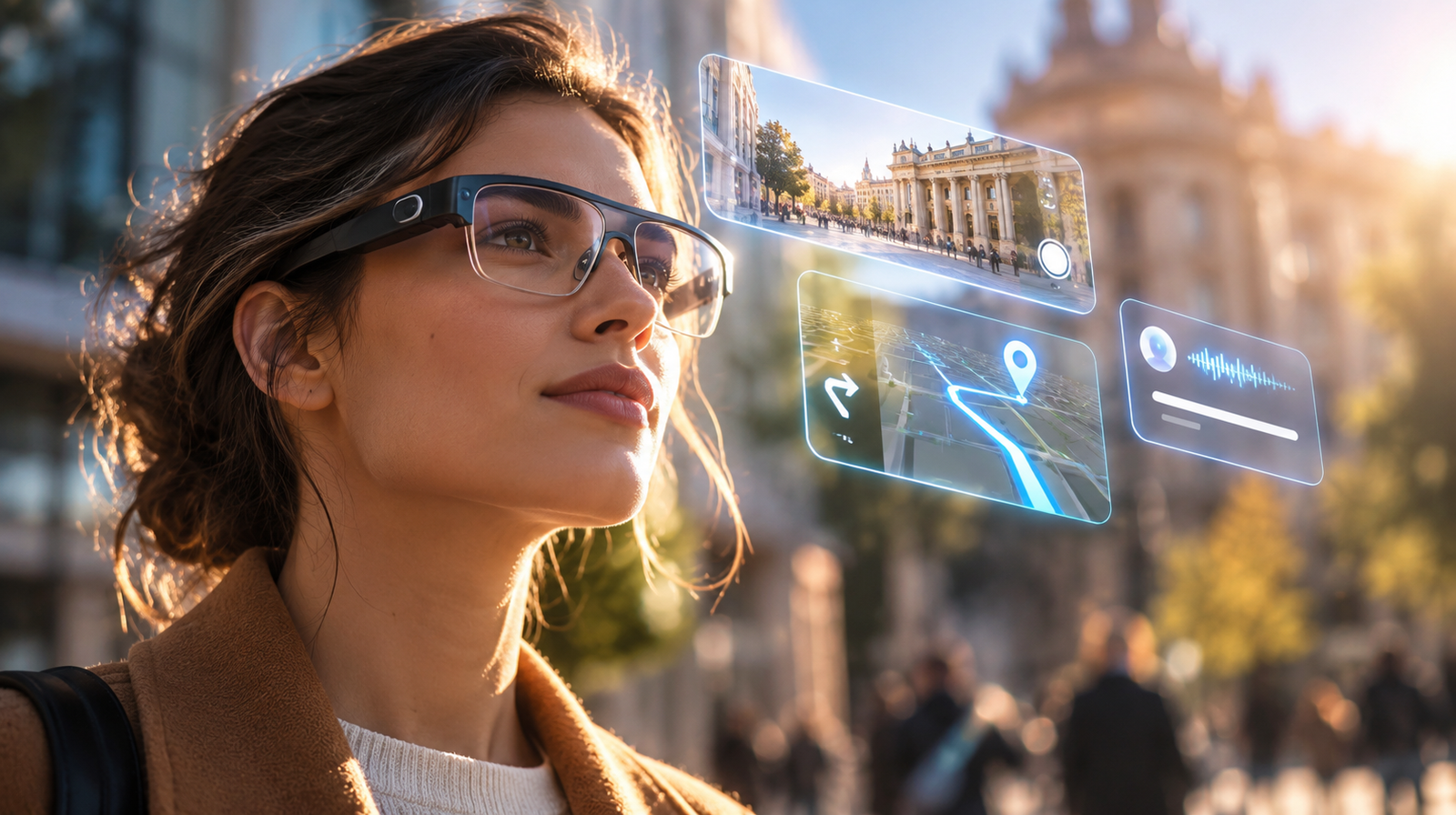
Smart glasses are finally becoming useful enough that the question is no longer simply whether the idea works.
The better question is what kind of smart glasses you are actually looking at.
In 2026, the category ranges from lightweight audio glasses that behave a little like open-ear earbuds, to camera-equipped AI glasses that can understand what you are looking at, and display models capable of putting navigation, notifications and other information directly in your field of view.
Those devices are often grouped under the same label, but their capabilities are very different.
For anyone following emerging gadgets on Techrow.gr, that distinction matters more than the futuristic marketing. Some smart-glasses features are already practical today, while others remain limited to specific models, markets or products that have been announced but have not yet reached general availability.
So what can smart glasses in 2026 really do?
First, there are now three very different types of smart glasses
The simplest way to understand the category is to stop treating every pair as miniature AR glasses.
Some models are essentially audio-first eyewear. They contain speakers and microphones but no camera or visual display. Meta’s newly announced Ray-Ban Meta Audio, for example, focuses on music, calls and hands-free AI interaction. The glasses weigh 43 grams and offer up to 12 hours of use, although they are currently still in pre-order and begin shipping on October 13.
The next category adds cameras and AI. Ray-Ban Meta Gen 3, which Meta says is available now, combines open-ear audio, microphones, Meta AI and a 12 MP camera capable of 3K video recording.
Then there are display glasses, such as Meta Ray-Ban Display, which can show information directly in front of the user. These support features including heads-up navigation and other glanceable interfaces, although availability remains limited to selected markets.
Google is adopting a similar distinction with Android XR, explicitly separating upcoming audio glasses from display glasses. Its first Gemini-powered audio models are expected later in fall 2026 rather than being broadly available today.
That difference is important because buying “smart glasses” does not automatically mean buying a display.
Yes, they can replace earbuds for some everyday tasks
Audio is arguably the most mature smart-glasses feature.
Current models can play music and podcasts through open-ear speakers while leaving the user’s ears physically uncovered. They can also handle phone calls through integrated microphones and speakers.
Meta says audio has become one of the most popular functions across its eyewear products, which is one reason the company introduced Ray-Ban Meta Audio as a dedicated audio-first model.
The practical advantage is obvious.
You can listen to something without putting earbuds inside your ears, while still hearing traffic, conversations and other sounds around you.
That does not automatically make smart glasses better than headphones. Audio quality, sound leakage and noisy environments still matter.
But for walking, casual listening and calls, the concept is no longer experimental.
Camera-equipped glasses can take photos without a phone
One of the clearest differences between ordinary eyewear and AI glasses is the camera.
Ray-Ban Meta Gen 3 includes a 12 MP camera capable of shooting photos and 3K Ultra HD video hands-free. Instead of taking out a smartphone, the wearer can use a button or voice command to capture what they are seeing.
Meta says photos and videos captured for the user’s gallery are initially stored privately on the glasses and can later be imported to the paired phone.
This is particularly useful when both hands are occupied or when taking out a phone would interrupt the moment.
The trade-off is that the framing is less deliberate than smartphone photography. You are essentially capturing from eye level rather than carefully composing an image on a display.
Smart glasses therefore make spontaneous capture easier, but they do not replace a phone when precise composition matters.
People around you can usually tell when Meta glasses are recording
Wearable cameras raise obvious privacy concerns.
Meta’s camera-equipped AI glasses use a front-facing white capture LED that flashes when a photograph is taken and continues blinking while video is being recorded.
On newer generations, Meta says the camera is automatically disabled if the system detects that the LED has been blocked or physically tampered with.
That does not settle the wider social debate around wearable cameras.
Someone wearing glasses does not need to visibly raise a phone before recording, so other people may still be less aware of the camera than they would be with conventional devices.
But the recording indicator is an important practical difference between legitimate consumer products and the idea of completely invisible covert recording.
AI can answer questions about the world around you
This is where the newest smart glasses become much more interesting than simple camera glasses.
With camera-equipped AI eyewear, the assistant can use visual context.
Instead of describing an object manually, the wearer can look at something and ask a question about it.
Google says its upcoming Gemini-powered eyewear will be able to identify or explain things the user sees, surface restaurant reviews, interpret signs and provide other visual assistance.
Meta also positions its AI glasses around contextual questions, local recommendations and hands-free AI assistance.
The practical difference compared with a phone is not necessarily intelligence.
You can already use AI vision tools on smartphones.
The difference is friction.
The camera is already pointing in approximately the same direction as your eyes, so the interaction can move directly from seeing something to asking about it.
Translation is one of the most natural smart-glasses features
Translation fits the form factor particularly well.
Google says its upcoming intelligent eyewear can translate both spoken language and visible text. A wearer could look at a menu or sign and hear a translation without manually photographing it first.
Meta similarly promotes live conversation translation across compatible AI-glasses experiences.
Again, smartphones already do this.
What glasses potentially improve is the flow of the interaction.
Instead of looking away from the person speaking or holding a phone between two people, the user can remain more engaged with their surroundings.
That is exactly the type of small convenience that may make smart glasses useful without making them feel like science fiction.
Navigation becomes much more interesting once a display is added
Audio glasses can give spoken directions.
Display glasses can go further.
Meta Ray-Ban Display currently supports heads-up navigation, placing turn-by-turn information inside the user’s view. Meta has also announced cycling and public-transit navigation, with some new functions rolling out first in the US and Canada.
The system can also provide more contextual walking directions. Meta gives the example of telling someone to turn at a visible landmark such as a yellow house rather than relying exclusively on street names.
This is one area where display glasses offer something a phone cannot replicate quite as naturally.
The user does not have to keep looking down at a map.
But it also illustrates why display glasses and ordinary AI glasses should not be confused. A pair without a display cannot visually overlay directions in front of you.
Notifications can appear directly in your view — on the right glasses
The same distinction applies to notifications.
Meta has announced mirrored phone notifications for Meta Ray-Ban Display, allowing selected alerts to appear on the glasses’ screen.
The user can choose which notifications should be shown.
This moves smart glasses closer to smartwatch territory: the goal is not necessarily to replace the phone, but to let the user decide whether something is important enough to justify taking the phone out.
For some people, that may reduce interruptions.
For others, putting notifications even closer to their eyes may feel like the exact opposite.
Calls are easy; video calls are more complicated
Standard voice calls work naturally on many smart-glasses models because microphones and speakers are already built in.
Video is more complicated.
The camera faces outward, meaning the person on the other end of a call would normally see what the wearer sees rather than the wearer’s face.
Meta is experimenting with an unusual solution on Meta Ray-Ban Display called Hologram. After creating a self-capture through the Meta AI app, the system can generate a photorealistic representation of the wearer for WhatsApp calls and animate it based on the user’s voice. The feature is scheduled to begin rolling out in Early Access in the US later in fall 2026.
That is interesting technology, but it is also a good example of why this article needs the words “right now” in the title.
Some of the most futuristic smart-glasses functions are still limited, staged rollouts rather than universal features.
Smart glasses can interact with phone apps
Another misconception is that smart glasses need an entirely separate application ecosystem before they become useful.
Google’s Android XR strategy is designed partly around the opposite idea.
Its upcoming intelligent eyewear pairs with both Android and iOS phones and can interact with connected apps. Google has demonstrated examples including requesting an Uber ride and preparing a DoorDash order through Gemini while leaving final confirmation to the user.
This means the glasses can function as another interface to services already running through the phone.
The smartphone does not disappear.
It simply spends more time in the user’s pocket.
No, smart glasses are not replacing smartphones yet
This is probably the most important reality check.
Current smart glasses are much better at short interactions than complex ones.
They are useful for asking a question, taking a photo, checking directions, hearing a notification, answering a call or starting a simple task.
They are not ideal for writing a long document, editing a spreadsheet, comparing dozens of products or browsing a complex website.
Most also remain dependent on smartphones for connectivity, apps, configuration or additional computing.
Google’s upcoming audio glasses explicitly pair with Android and iOS devices, while Meta’s ecosystem similarly relies heavily on a companion phone and Meta AI app for many functions.
So the best way to understand current smart glasses is not as phone replacements, but as devices that reduce how often you need to pull the phone out.
Some smart glasses do not have cameras at all
This matters particularly for people who like the concept but dislike wearable cameras.
Meta’s Ray-Ban Meta Audio removes both the camera and visual display, focusing instead on speakers, microphones and AI. The company describes the product as combining earbuds and AI inside conventional eyewear.
That creates a very different privacy and use-case profile.
The glasses can be used for music, calls and AI interaction without continuously carrying a forward-facing camera.
For many users, this category may actually be easier to accept socially than more capable camera glasses.
And some smart glasses do not have AI
The term “smart glasses” has become broad enough to include products with very different levels of intelligence.
Some models are essentially Bluetooth audio eyewear.
Others add cameras.
Others integrate generative AI assistants.
A smaller group adds visual displays.
So features should always be checked model by model, rather than assumed from the product category.
This is particularly important in 2026 because the market is changing quickly and companies are releasing several products under closely related names.
Google’s glasses are important — but many are still “coming soon”
Google’s 2026 Android XR announcements are particularly impressive on paper.
Gemini-powered audio glasses are designed to answer questions about what the wearer sees, provide natural navigation, translate speech and writing, manage calls and messages, capture photos and video, interact with apps and assist with multi-step tasks.
But there is an important qualification.
Google’s first audio glasses are scheduled for later in fall 2026. As of September 30, the announced Gentle Monster and Warby Parker models should therefore be treated as upcoming products rather than features that every consumer can already buy and use today.
Display models are another step after that.
This is why the current market remains more mature on Meta’s side than Google’s, even though Android XR gives a strong indication of where the category is going.
Meta currently offers the clearest example of a mature product range
Meta’s advantage in 2026 is that several levels of the smart-glasses concept already exist within one product family.
Ray-Ban Meta Gen 3 is available now with cameras, AI, speakers and microphones. Meta Ray-Ban Display adds a visual interface in supported markets. Ray-Ban Meta Audio is scheduled to ship in October for users who want audio and AI without a camera.
That makes the differences between categories easier to see.
You can increasingly choose between:
less hardware and more subtlety, or more capability and a more complex device.
There is no single version of smart glasses that is automatically best.
Battery life still decides how “all-day” the experience feels
Wearable technology becomes much less convenient if it constantly needs to be removed and charged.
That remains one of the main hardware constraints.
Meta says Ray-Ban Meta Gen 3 reaches up to nine hours of battery life, while the upcoming Ray-Ban Meta Audio is rated for up to 12 hours plus additional charging from its case.
Actual endurance will naturally depend on how heavily features such as calls, audio, cameras and AI are used.
The broader point is that manufacturers are now designing around something closer to an all-day eyewear routine, rather than a short technology demonstration.
But battery life is still far from irrelevant.
Displays remain the biggest hardware compromise
Adding a display unlocks some of the most impressive smart-glasses functions.
It also makes the device harder to build.
Displays add complexity, power consumption, optical components and interface challenges that audio-first models can avoid.
That is why much of the market is currently splitting into two paths.
Audio and camera glasses aim to look as conventional as possible.
Display glasses accept more complexity in exchange for visual navigation, notifications and other heads-up information.
The published Athens Pulse article, “Why Smart Glasses Are Starting to Feel Normal” examined why the first path may be especially important for adoption: technology becomes easier to accept when it starts to disappear into ordinary eyewear.
What smart glasses can do also depends on where you live
Availability is another limitation that is easy to miss in launch announcements.
Meta Ray-Ban Display, for example, expanded in September to the UK and Canada, while France, Italy and Germany were beginning pre-orders ahead of October availability.
Specific AI, navigation or language features can also vary by region.
Google’s new intelligent eyewear is only beginning its first commercial rollout later this fall.
So a feature existing technically does not necessarily mean it is available in your country, on your model and in your language.
That is worth checking carefully before buying any pair based on one headline feature.
Marketing and business ambitions are much larger than the hardware itself
Smart glasses are also becoming interesting for reasons that have little to do with camera resolution or speakers.
The already published Targeted.gr article “When the Screen Moves to Your Face: What AI Glasses Could Change for Marketing” examined how wearable AI could change local discovery, visual search, voice interaction and the way customers encounter businesses without first opening a traditional webpage.
The Market Insiders article “The Business of the Next Interface: Who Controls the Smart Glasses Ecosystem?” looked at an even larger question: whether Meta, Google or another ecosystem ultimately controls the AI assistant, apps and services that sit between the glasses and the user.
Those possibilities matter.
But for someone considering the technology today, the immediate reality is much simpler.
Do you want audio?
A camera?
AI?
A display?
Those four questions tell you far more about the product than the generic phrase “smart glasses”.
So what can smart glasses actually do in 2026?
The answer is considerably more than a few years ago, but still much less than science-fiction eyewear.
Current products can genuinely handle music, calls, hands-free photography and video, AI conversations, contextual questions and, on compatible models, translation. Display glasses can add navigation, notifications and additional visual experiences. Google’s upcoming Android XR products expand the idea further with Gemini-based visual understanding and app interactions.
What they cannot yet do is replace every major function of a smartphone inside a lightweight pair of normal-looking glasses.
And perhaps they do not need to.
The category is becoming useful because it is learning to focus on the moments when taking out the phone feels unnecessary.
A quick photo.
A call.
A direction.
A translation.
A question about something in front of you.
A notification you want to check without stopping.
That may sound less dramatic than the old promise of putting an entire computer in front of your eyes.
But it is also much closer to something people can actually use.
Frequently Asked Questions
What can smart glasses do in 2026?
Depending on the model, they can play audio, make calls, take photos and video, access AI assistants, translate languages and answer questions about the user’s surroundings. Display models can also show navigation, notifications and other visual information.
Do all smart glasses have a display?
No. Many of today’s most practical smart glasses have no display at all. Some are audio-only, while others add cameras and AI without placing visual information in front of the user’s eyes.
Can smart glasses take photos?
Camera-equipped models can. Ray-Ban Meta Gen 3, for example, includes a 12 MP camera and can record 3K video hands-free.
Can smart glasses translate languages?
Some AI glasses support or are designed to support spoken and visual translation. Google’s upcoming Gemini glasses can translate speech as well as text visible on menus and signs.
Can smart glasses give directions?
Yes, but the experience depends on the hardware. Audio models can provide spoken navigation, while display glasses such as Meta Ray-Ban Display can show turn-by-turn information in the user’s field of view.
Can smart glasses replace earbuds?
Audio-focused models can cover many similar uses, including music, podcasts and calls. Because the speakers are open-ear, however, the experience is different from in-ear headphones.
Can smart glasses replace a smartphone?
Not currently. Most remain connected to a smartphone and are best suited to quick, hands-free interactions rather than complex screen-based tasks.
Are Google’s Gemini smart glasses available now?
Google has announced its first Android XR audio glasses for later in fall 2026. As of September 30, they should still be considered upcoming rather than broadly available consumer products.
Are smart-glasses cameras always recording?
No. Camera-equipped Meta glasses record when the user initiates capture. Meta uses an external LED to indicate photography or video recording and disables the camera on newer models if the LED is detected as blocked or tampered with.
Which type of smart glasses makes the most sense?
It depends on what you want. Audio-first glasses suit music, calls and AI with minimal hardware; camera-equipped models add hands-free capture and visual AI; display glasses add navigation and glanceable information but are currently more complex and less widely available.