
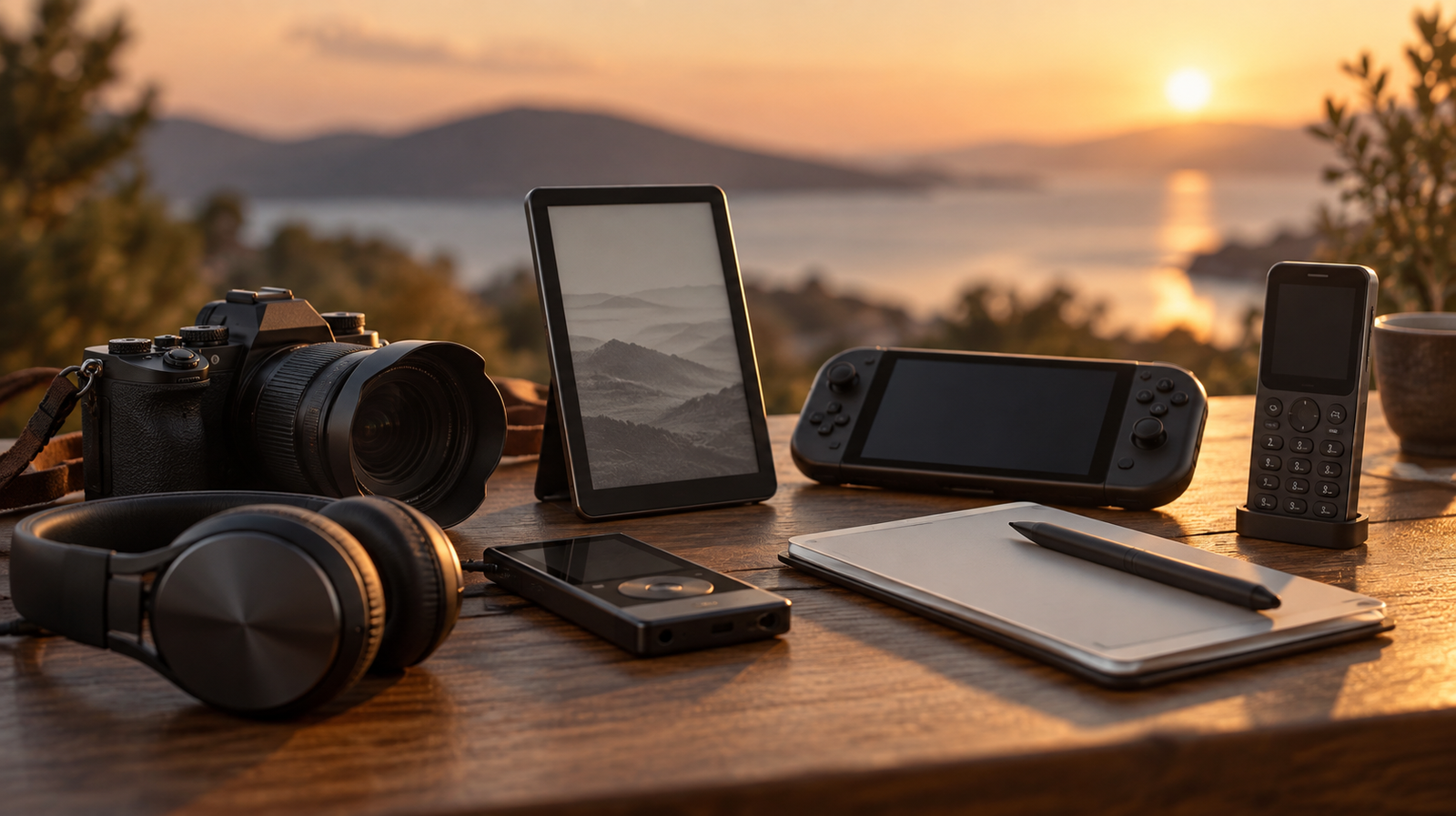
The smartphone replaced an extraordinary number of devices. It became a camera, music player, GPS, notebook, gaming device, alarm clock and communication hub, all inside a single screen.
That convenience is difficult to beat. Yet single-purpose tech is beginning to make sense again for a different reason: sometimes a device becomes better at one activity precisely because it does not try to handle everything else.
E-readers, dedicated cameras, handheld gaming systems, minimalist phones and distraction-free writing devices all follow versions of the same idea. They give up some versatility in exchange for focus, physical controls, longer battery life or an experience built around one particular use.
For Techrow.gr, the interesting question is not whether these devices can replace the smartphone. In most cases, they cannot. It is whether carrying a second, more focused device can sometimes provide a better experience than asking one screen to do everything.
The Smartphone Won the All-in-One Device Race
There is a reason dedicated gadgets disappeared from many pockets and bags: smartphones became remarkably capable. A modern phone can capture high-quality photos and video, stream music, display books, provide navigation, run games, handle banking and connect users to almost any online service.
For most people, that consolidation remains a major advantage. One device means one battery to charge, one interface to learn and one object to carry. The return of single-purpose tech therefore does not suggest that the smartphone model has failed. In many ways, the opposite is true.
Smartphones became so effective at combining different activities that some users are now rediscovering the benefits of separating those activities again. A dedicated device does not need to replace the smartphone to justify its existence. It only needs to offer a noticeably better experience for one particular task.
An E-Reader Does Less Than a Tablet — and That Is the Point
A conventional tablet is far more versatile than an e-reader. It can stream video, browse the web, run games, handle messaging and support thousands of applications, while an e-reader remains centred primarily around one activity: reading.
On paper, the tablet clearly wins on capability. In practice, that comparison misses much of the reason people choose dedicated reading devices. An e-reader offers an environment built around books rather than apps, notifications and entertainment, while its display technology and interface are designed specifically for long-form reading.
Its limitations therefore become part of the experience rather than simply a weakness. The user picks up the device primarily to read, with far fewer competing reasons to leave the book and move into another digital activity. A tablet offers more possibilities; an e-reader offers greater focus.
Dedicated Cameras Still Offer More Than Image Quality
Smartphone cameras have improved so dramatically that many users no longer need to carry a separate camera. Yet dedicated cameras continue to appeal to photographers for reasons that extend beyond resolution, sensor size or technical image quality.
Physical controls, ergonomics, lenses and the overall shooting experience all matter. A dedicated camera is designed around photography from the moment it is picked up, without work messages, social notifications or unrelated applications competing for attention. Photography stops being one function among hundreds and becomes the device’s central purpose.
That separation can affect behaviour as much as image quality. Using a camera can encourage a more deliberate approach to photography because the device itself creates a clear context for the activity. There is, of course, a trade-off: another device must be carried, charged and maintained, and images may need to be transferred before they can be shared. Single-purpose tech almost always asks the user to exchange some convenience for a more focused experience.
Minimalist Phones Take the Idea Further
A minimalist phone takes this philosophy further because it deliberately gives up one of the smartphone’s greatest strengths: access to a vast app ecosystem. Calls, messages and a limited set of useful tools may remain, while social feeds, games and other applications are reduced or removed altogether.
That sounds restrictive because it is, and the restriction is often the point of the product. For someone who relies on mobile banking, advanced navigation, work apps and constant connectivity, a minimalist phone can be deeply inconvenient. For someone who wants a device that cannot turn every quiet moment into another opportunity to scroll, the same limitation can become useful.
The relevant question is therefore not whether minimalist phones are objectively better than smartphones. It is better for what? A general-purpose smartphone maximises flexibility, while a minimalist phone can create stronger boundaries around communication and screen use.
Dedicated Music Players Solve a Problem the Smartphone Already Solved
Portable music is another category where smartphones already provide an excellent solution. Streaming services offer enormous catalogues, Bluetooth connects easily to headphones and speakers, and downloaded music allows offline listening without the need for another device.
Yet dedicated music players still make sense for certain users. Some value specialised audio hardware, while others prefer local music libraries, additional storage, separate battery usage or simply the ability to listen without calls, messages and social notifications entering the same experience.
The advantage is therefore not always functional necessity. It can also be behavioural. Using a dedicated music player turns listening into a more intentional activity rather than something that happens inside the same device responsible for work, communication and social media. A separate player may not be essential, but for some users it can make listening feel more purposeful.
Handheld Gaming Shows Why Dedicated Hardware Still Matters
Gaming offers one of the clearest examples of why dedicated devices can remain valuable even when smartphones are powerful enough to run increasingly sophisticated games. A handheld gaming system is designed around gaming from the beginning, with physical controls, an interface centred on a game library and hardware shaped for longer play sessions.
The smartphone remains more versatile, but versatility is not always the most important advantage. Touch controls can work well for some games, yet they cannot always reproduce the precision and tactile feedback of buttons, triggers and analogue sticks.
A dedicated handheld therefore provides a more coherent experience for one specific activity. Every part of the device reinforces the same purpose, which helps explain why specialised gaming hardware continues to exist alongside increasingly powerful smartphones.
Physical Controls Can Be Better Than Infinite Flexibility
Touchscreens solved an enormous interface challenge by allowing the same surface to become almost anything. A keyboard can appear when required, camera controls can change between modes and different applications can redesign the entire interface.
That flexibility is powerful, but physical controls still offer advantages that software cannot always reproduce. A camera shutter button can be found without looking at the screen, a volume wheel gives immediate tactile feedback, a game controller allows actions to become muscle memory and a physical page-turn button performs one predictable task every time.
Because single-purpose devices have fewer jobs to perform, their hardware can be optimised around a smaller number of actions. An all-purpose device has to remain flexible enough for many different uses, while a dedicated one can afford to become highly specific.
Less Software Can Mean Less Maintenance for the User
General-purpose devices require continuous management. Applications update, notifications accumulate, storage fills, permissions change, accounts require authentication and background services compete for battery life and attention.
A simpler device can reduce some of that overhead because its software environment is narrower. An e-reader, camera or dedicated music player may still require firmware updates and occasional maintenance, but there are usually fewer services, settings and applications competing for the user’s attention.
That narrower environment can make the device feel more predictable over time. The user generally knows what it is for, what it will do and what it will not suddenly ask them to manage. For some people, that kind of predictability is becoming a feature in its own right.
Battery Life Changes When a Device Has One Main Job
Dedicated devices can also benefit from hardware and software designed around a narrower workload. An e-reader does not need to behave like a high-refresh multimedia tablet throughout the day. A basic phone may avoid many of the background processes that define a modern smartphone, while a dedicated music player can focus its power management primarily on audio playback.
This does not mean every single-purpose device automatically offers exceptional battery life. Hardware quality, display technology and software optimisation still matter. What changes is the design priority.
A device built around one main task can allocate its hardware, interface and power consumption around that purpose rather than constantly balancing dozens of unrelated activities. In the right category, that narrower focus can translate into a simpler and more efficient everyday experience.
The Real Cost Is Carrying Another Device
The strongest argument against single-purpose technology is also the most obvious one: dedicated devices create hardware duplication. A smartphone user who adds an e-reader, camera and music player suddenly owns four devices instead of one.
That means more batteries, charging cables, accessories, storage requirements, potential repairs and physical objects to carry. The smartphone became successful partly because it solved exactly this problem by consolidating several devices into one.
For that reason, single-purpose tech makes the most sense when the improvement to a particular activity is significant enough to justify the additional hardware. Someone who reads every day may easily find room for an e-reader, while someone who opens a book only occasionally may be perfectly satisfied with a phone or tablet.
The value therefore depends less on the specifications of the dedicated device and more on how often the user benefits from its specialised experience.
A Focused Device Can Create a Boundary
Perhaps the most interesting advantage of single-purpose technology is not technical at all. A dedicated device can create a clear boundary between different activities.
Reading happens on one device, gaming on another and photography through a camera. Essential communication may happen on a simpler phone. That separation can make digital behaviour more intentional because entering an activity requires physically choosing the device associated with it.
The Athens Pulse article “Why People Are Buying Tech That Does Less” looks at this broader behavioural shift and why some users are becoming attracted to technology that introduces clearer limits into everyday digital life.
From a Techrow.gr perspective, the practical implication is that hardware design influences more than capability. It can also shape how likely we are to use a device for a particular purpose, how long we remain focused on that activity and how easily something else interrupts it.
Simplicity Can Also Make a Product Easier to Understand
A dedicated device often has an advantage before it is even switched on: its purpose is immediately clear. An e-reader is for reading, a camera is for photography and a handheld console is for gaming.
That clarity can be increasingly valuable in a market where many consumer devices overlap in functionality. General-purpose products often require the user to configure, customise or mentally separate different activities, whereas a focused device arrives with a much clearer identity.
The Targeted.gr article “The Anti-Feature Consumer: When Simplicity Becomes a Marketing Advantage” examines the marketing side of this shift and why a narrower proposition can sometimes be easier to communicate than a long feature list.
For the user, the practical benefit is even simpler: there is less need to transform the device into the tool they wanted. It was already designed to perform that role.
Fewer Features Can Also Mean Fewer Things to Maintain
There is another side of focused technology that users rarely see directly. Every additional feature can create new requirements for testing, updates, documentation, support and compatibility with the rest of the product.
The Market Insiders article “Feature Creep: When More Product Features Create More Cost Than Value” examines that organisational cost and how continuous expansion can eventually make a product harder and more expensive to maintain.
Users experience the consequences indirectly. A product with a narrower feature set can sometimes feel more stable, easier to understand and more consistent because its development team has fewer behaviours and edge cases to support.
That does not mean fewer features automatically produce better software. It does show, however, why continuously adding capabilities is not always the most reliable path toward a better device.
Single-Purpose Does Not Have to Mean Primitive
Focused technology should not be confused with primitive technology. A dedicated camera can contain extremely sophisticated imaging hardware, an e-ink tablet can support cloud syncing and advanced handwriting features, and a handheld gaming system can essentially be a powerful portable computer.
The term single-purpose tech therefore refers less to how complex the technology is internally and more to the clarity of what the device is primarily designed to accomplish.
Advanced hardware and focused design can coexist. A device may deliberately perform fewer types of tasks while using highly sophisticated technology to perform those tasks exceptionally well.
In that sense, doing less does not necessarily mean offering less engineering. It can mean concentrating that engineering around a narrower purpose.
When Does a Dedicated Device Actually Make Sense?
The most useful way to evaluate a dedicated device is not to ask whether it can do more than a smartphone. In most cases, it cannot.
The better question is whether it meaningfully improves an activity the user performs frequently. An e-reader may make long reading sessions more comfortable, a dedicated camera can make photography more enjoyable and controllable, a handheld console may provide a gaming experience that feels far more natural than playing on a touchscreen, while a minimalist phone can help create boundaries that are difficult to maintain on a conventional smartphone.
If that improvement is meaningful and repeated often enough, the inconvenience of carrying another device may be justified. If the difference is marginal, however, another gadget may simply become additional clutter.
Single-purpose technology makes the most sense when its specialisation changes the experience, not merely when it adds another object to the desk or bag.
The Best Device Is Not Always the One With the Most Features
The rise of the smartphone demonstrated how useful consolidation can be. One device replaced cameras, music players, navigation systems, notebooks and numerous other gadgets for millions of users.
The renewed appeal of single-purpose tech adds another lesson: consolidation is not always the same as optimisation.
A smartphone may perform ten different activities extremely well, yet a dedicated device can still provide a better experience for one of them because its hardware, software and interface all point toward the same purpose.
That does not mean consumers are returning to a world where everyone carries a separate camera, MP3 player, GPS device and phone. A more realistic model is a combination of both approaches: one general-purpose device remains at the centre, while selected dedicated gadgets return where their advantages are meaningful enough to justify the extra hardware.
Sometimes the best technology is the device that can do almost everything. At other times, the better tool is the one that knows exactly what it is there to do.
Frequently Asked Questions
What is single-purpose tech?
Single-purpose tech refers to devices designed primarily around one activity or a narrow group of related tasks, rather than trying to function as an all-purpose computing device.
Why are dedicated devices becoming appealing again?
They can offer a more focused experience, specialised hardware, physical controls and fewer distractions than multipurpose devices such as smartphones and tablets.
Is an e-reader better than a tablet?
It depends on the use case. A tablet offers significantly more functionality, while an e-reader is designed specifically around reading and may provide a more focused experience for frequent readers.
Why use a dedicated camera when smartphones have good cameras?
Dedicated cameras can provide specialised controls, interchangeable lenses, different ergonomics and a photography-focused experience. Whether those benefits justify carrying another device depends on the user.
Are minimalist phones practical?
They can be practical for users who mainly need calls, messages and a limited number of functions. They may be unsuitable for people who depend heavily on smartphone apps for work, banking, navigation or everyday services.
Does single-purpose technology mean outdated technology?
No. A focused device can use advanced hardware and software while deliberately limiting the number of tasks it is designed to perform.
Should I replace my smartphone with dedicated devices?
Not necessarily. For most users, the smartphone remains the most convenient general-purpose device. Dedicated technology makes the most sense when it provides a meaningful improvement to an activity you perform frequently.