
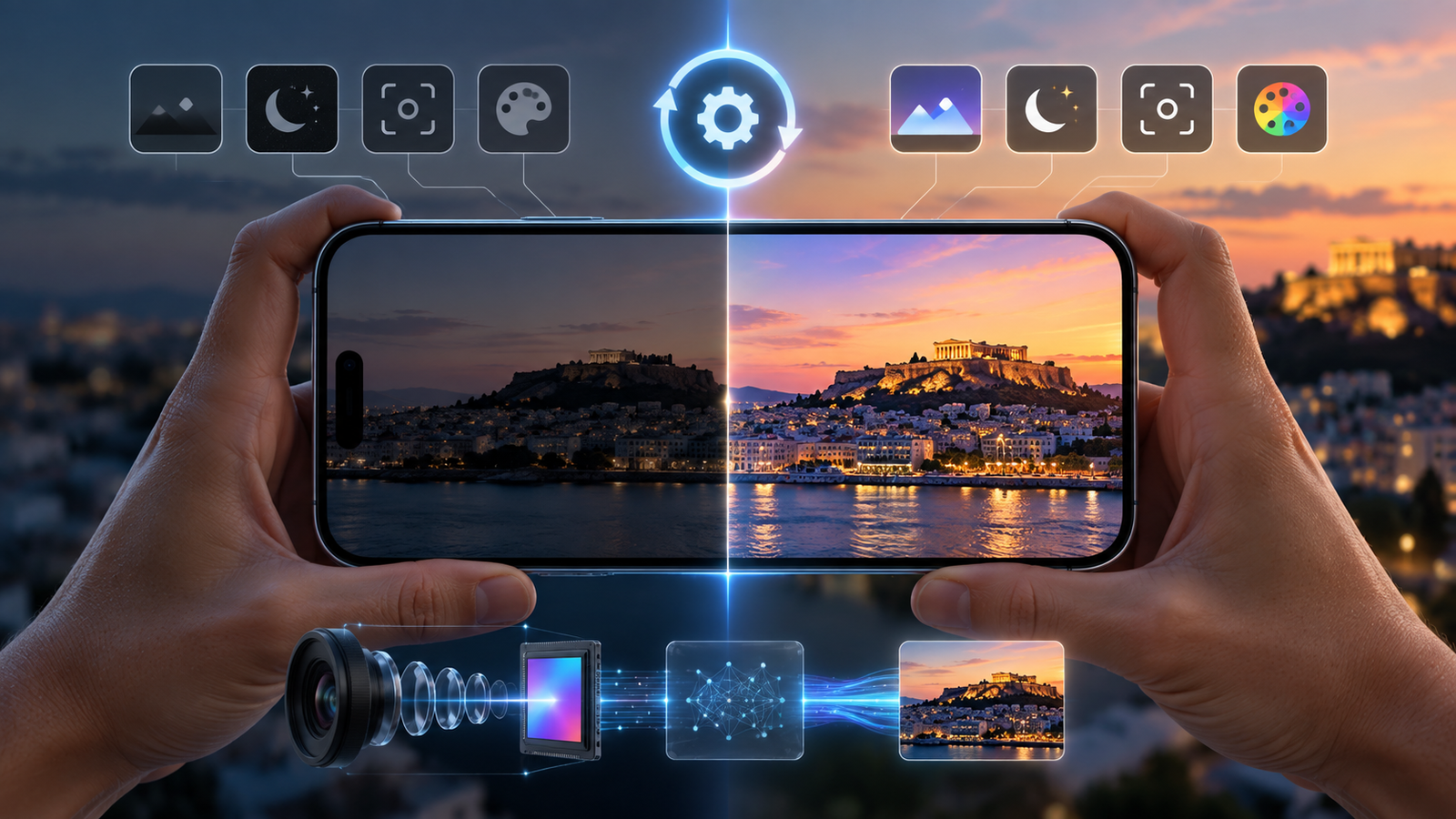
You buy a new smartphone, test its camera and quickly learn how it handles faces, night shots, skin tones and HDR. Then, a few months later, something may feel different.
The hardware hasn’t changed. The same sensors and optics are still there. Yet Smartphone Cameras Look Better — or sometimes worse — after a software update. Photos can suddenly look sharper, darker, brighter, more natural or more processed than before.
Autofocus may become more reliable, night mode can behave differently, skin tones may change and HDR can become more or less aggressive.
So, did the software update actually change your camera?
It can. Modern smartphone photography relies heavily on software, meaning the camera experience you get at launch may not be exactly the same a year later. Smartphone Cameras Look Better when manufacturers improve image processing, but an update can also make certain photos look worse.
Techrow.gr examines why camera quality can change after software updates and what manufacturers can improve without changing the smartphone’s hardware.
A Smartphone Camera Is Much More Than a Sensor and Lens
When smartphone cameras are compared, hardware specifications naturally receive much of the attention.
Sensor size, megapixels, aperture, focal length and optical stabilization are all important. These characteristics establish physical limits and capabilities that software cannot simply erase.
But the image recorded by the sensor is not necessarily the image you eventually see in the gallery.
Between pressing the shutter and viewing the finished photograph, the smartphone can perform an enormous amount of computational work. It may combine information from multiple exposures, identify faces, recover highlights, brighten shadows, reduce noise, sharpen fine detail and adjust colors.
The final photograph is therefore the result of both optics and computation.
And while the optics remain physically fixed after purchase, much of that computation can change through software.
The Camera Hardware Stays the Same — the Image Pipeline Does Not
Think of the smartphone camera as the beginning of a processing pipeline.
Light reaches the sensor and produces raw image data. From there, algorithms decide how that information should become the photograph presented to the user.
Those decisions can include exposure, white balance, HDR, contrast, saturation, sharpening, noise reduction and tone mapping.
Manufacturers can modify many of these parameters through updates.
That means a software update does not need to make the sensor physically better to improve the final photograph.
It can simply make better decisions with the information the sensor was already capturing.
This is one reason smartphone cameras can evolve after launch in a way that would have seemed unusual in traditional consumer photography.
Computational Photography Makes Camera Quality Updatable
Computational photography has fundamentally changed what smartphone cameras can do.
A phone can capture multiple frames before and after the shutter is pressed, analyze them and combine useful information into a single image. Different exposures can help preserve bright skies while maintaining detail in darker areas. Multiple frames can help reduce noise in low light.
The important point is that these processes depend heavily on algorithms.
If a manufacturer improves the algorithm responsible for combining those frames, the physical camera does not need to change.
The resulting image can still improve.
This makes modern smartphone photography partly software-defined.
The hardware determines what information is available. Software plays a major role in deciding what to do with it.
HDR Can Change Dramatically After an Update
HDR is one of the clearest examples.
Imagine photographing a person standing in front of a bright window. The camera needs to preserve detail in both the face and the background, despite the enormous difference in brightness.
Smartphones often solve this computationally by combining multiple exposures and applying local tone adjustments.
An update can change how aggressively this happens.
A manufacturer might decide that previous processing made shadows too bright, producing an unnatural flat appearance. Another update might improve highlight recovery or reduce halos around difficult edges.
After the update, the same scene can produce a noticeably different photograph.
The sensor did not improve.
The phone simply learned to interpret the scene differently.
Night Mode Is Especially Dependent on Software
Low-light photography is another area where software has enormous influence.
Small smartphone sensors have physical disadvantages when very little light is available. Modern phones compensate by capturing multiple frames over a period of time and combining them computationally.
The software has to make numerous decisions.
How long should the exposure sequence last? How much noise should be removed? How much detail should be preserved? How should movement between frames be handled? How bright should the final image become?
Changes to these decisions can make night photography look dramatically different after an update.
A new version may reduce noise more effectively but also remove fine texture. Another may preserve more detail while allowing additional grain to remain.
Neither approach is automatically better in every situation.
Camera tuning always involves trade-offs.
Sharper Does Not Always Mean Better
Smartphone manufacturers know that sharp images often look impressive, particularly when viewed quickly on a phone screen.
Software sharpening can emphasize edges and create the appearance of additional detail. Used carefully, it can improve clarity.
Used too aggressively, it can create unnatural textures and visible halos around objects.
An update may therefore reduce sharpening even if that makes the image appear slightly softer at first glance.
Some users will consider the new result more natural.
Others will say the update made the camera worse.
Both may be describing the same technical change.
This illustrates an important point: image quality is not always a simple scale from worse to better.
Some changes reflect different priorities rather than objective improvements.
Noise Reduction Creates the Same Trade-Off
Noise reduction presents a similar problem.
In low light, image sensors produce visible noise. Software can smooth that noise, creating a cleaner-looking photograph.
But aggressive noise reduction can also erase fine details.
Hair, fabric, grass and skin texture may begin to look artificial or overly smooth.
Manufacturers constantly balance these competing goals.
An update that preserves more detail may intentionally leave more visible noise. Another that produces cleaner images may sacrifice texture.
When users compare photographs before and after an update, they may therefore disagree because they value different characteristics.
One person sees improved detail.
Another sees more noise.
Both observations can be correct.
Color Science Can Change Too
People often develop strong preferences for the way particular smartphones reproduce color.
Some phones are associated with vibrant images. Others aim for more restrained processing. Skin tones can also become a major point of comparison between devices.
These characteristics are not determined entirely by the sensor.
Software plays a substantial role.
A manufacturer can modify white balance behavior, saturation, tone mapping and other aspects of color reproduction through updates.
This can change the photographic “character” of the camera even when technical detail remains similar.
For a user who liked the previous look, the change may feel like a downgrade.
For someone who considered the original processing unrealistic, it may feel like an improvement.
Autofocus Can Improve Without Changing the Lens
Not every camera update changes the visual processing of the image.
Software also influences how reliably the camera captures the photograph in the first place.
Autofocus algorithms can be refined. Subject detection can improve. Face and eye detection can become more reliable, while transitions between focus points can become smoother in video.
This matters because a technically excellent camera is of little value if it regularly focuses on the wrong subject.
For everyday smartphone photography, consistency can be more important than the maximum quality achievable under perfect conditions.
A camera update that produces fewer missed shots may therefore be more valuable than one that makes already-good photographs slightly sharper.
Portrait Mode Can Become More Convincing
Portrait photography provides another example of software-driven improvement.
Creating artificial background blur requires the smartphone to determine which parts of the image belong to the subject and which belong to the background.
Hair, glasses, fingers and complicated edges can make this difficult.
Better segmentation algorithms can improve that separation without any change to the camera hardware.
An update may therefore produce more natural portraits simply because the phone has become better at understanding the geometry of the scene.
This illustrates how smartphone camera development increasingly overlaps with computer vision.
The camera is not merely capturing light.
It is also attempting to understand what it is looking at.
Zoom Can Benefit From Better Processing
Telephoto performance is heavily influenced by hardware, particularly when a smartphone has a dedicated optical zoom camera.
But software still matters.
At intermediate zoom levels, smartphones may combine sensor cropping, multiple frames and computational processing. Manufacturers can improve how information is fused or how detail is reconstructed.
An update can therefore improve certain zoom levels even though the optical system has not changed.
The reverse is also possible.
More aggressive processing may create images that initially appear sharper but contain unnatural textures or reconstructed detail that some users dislike.
Again, the question is not simply whether more processing is better.
It is whether the processing produces a result users find useful and believable.
Video Can Change After an Update Too
Software updates can also affect video recording.
Stabilization algorithms can be adjusted, autofocus transitions refined and exposure behavior changed. Manufacturers may also modify how the phone handles noise, dynamic range or switching between cameras during recording.
For creators, these changes can be particularly important.
A phone that produces excellent still photographs but inconsistent exposure transitions may be frustrating for video. A later update could improve the experience significantly without changing a single piece of hardware.
The opposite can happen if a new algorithm introduces unexpected behavior.
This is why camera evaluation should include both photography and video rather than treating them as interchangeable measures of quality.
Why Would an Update Make the Camera Worse?
If manufacturers can improve cameras through software, an obvious question follows: why would an update ever make photographs worse?
Because camera processing involves trade-offs.
Reducing noise can remove detail. Increasing HDR can make images look unnatural. Stronger sharpening can create artifacts. Brighter night photographs can lose the atmosphere of the original scene.
An update may also fix one problem while unintentionally introducing another.
There is another complication: manufacturers tune cameras for millions of scenes and millions of users. A processing change that improves the average result may perform worse in a particular scenario.
So when someone reports that an update “ruined the camera,” the experience may be genuine without necessarily meaning that every aspect of the camera became universally worse.
What Looks Better Is Partly Subjective
Smartphone camera comparisons often become debates about aesthetics.
Should shadows remain dark, or should HDR reveal more information?
Should night mode reproduce the darkness of the actual scene, or brighten it so that more detail becomes visible?
Should colors be accurate, or slightly more vibrant?
There is no purely technical answer to every question.
Manufacturers develop a photographic style, and software updates can subtly change that style.
This is why two people can examine the same before-and-after comparison and reach opposite conclusions.
The software may have changed objectively.
Whether the result is an improvement can remain partly subjective.
Early Reviews Can Become Outdated
This has an important consequence for anyone researching a smartphone.
Most major reviews appear around launch.
But launch software is only one version of the device.
If camera processing changes substantially through later updates, photographs included in an early review may no longer perfectly represent what a buyer will receive months later.
This does not make the original review wrong.
It makes it historically accurate.
The reviewer evaluated the product that existed at that moment.
For buyers considering an older flagship, it can therefore be useful to look for recent camera samples and long-term reviews rather than relying entirely on launch coverage.
Public Conversations Can Preserve Older Versions of the Camera
Software evolution also creates an interesting online problem.
A community discussion from launch month may complain about poor autofocus or overly aggressive HDR. Months later, an update fixes the issue.
But the original discussion remains searchable.
Someone researching the phone may encounter both old complaints and newer positive experiences without immediately realizing that the users are effectively discussing different versions of the camera software.
Targeted.gr examines this wider marketing dynamic in “When Customers Research in Public: How Online Communities Shape Brand Perception” exploring how searchable customer conversations can continue influencing brand perception long after the original experience has changed.
For technology products that evolve through updates, timestamps therefore matter.
A camera opinion is partly an opinion about a particular software version.
Camera Changes Can Affect the Reputation of More Than One Phone
Manufacturers also develop recognizable approaches to image processing across multiple devices.
If users strongly dislike a particular change in one flagship, the discussion can influence expectations surrounding other phones from the same company.
Likewise, an exceptionally successful camera system can improve perceptions of the manufacturer’s broader photography capabilities.
Market Insiders explores this broader business effect in “The Reputation Spillover Effect: How One Product Can Change the Value of an Entire Brand” examining how experiences with an individual product can influence expectations and value across a wider portfolio.
For smartphone manufacturers, camera tuning therefore has implications beyond individual photographs.
The photographic experience can become part of the identity of the brand itself.
Why Users Sometimes Trust Their Own Eyes More Than Specifications
Camera software also demonstrates why technical specifications alone cannot completely describe photographic performance.
Two smartphones can use similar hardware and still produce noticeably different images because their processing philosophies differ.
This encourages buyers to search for camera samples, user experiences and independent comparisons rather than relying entirely on specification sheets.
But even those sources require interpretation. Users may have different software versions, preferences and shooting conditions.
Athens Pulse examines the wider psychology behind this reliance on peer experience in “Why Do We Trust Strangers on the Internet More Than Brands?”, exploring how relatability, perceived independence and social proof influence online credibility.
For camera buyers, the practical lesson is not that official information is useless or that strangers are automatically more reliable.
It is that different sources answer different questions.
Can Manufacturers Intentionally Reduce Camera Quality?
This question occasionally appears after users notice differences following an update.
A change in image processing alone does not demonstrate that a manufacturer intentionally degraded a camera. There are many more ordinary explanations, including algorithm changes, bug fixes, attempts to improve consistency or different trade-offs in processing.
Determining deliberate degradation would require evidence beyond subjective before-and-after impressions.
It is therefore more useful to identify what specifically changed.
Are images darker? Is sharpening stronger? Has noise reduction increased? Does autofocus behave differently? Are the differences repeatable under comparable conditions?
Specific observations provide much more useful information than simply saying that the camera “feels worse.”
How to Compare Camera Quality Before and After an Update
A meaningful comparison requires consistency.
Ideally, photographs should be taken from the same position, with the same lens or zoom level, under similar lighting and using the same camera mode.
Automatic photography introduces some unavoidable variation, so multiple images are more useful than a single pair.
Look separately at exposure, highlight preservation, shadow detail, color, noise, texture, sharpening and autofocus reliability.
Video should also be evaluated independently.
Most importantly, avoid judging an entire camera update from one unusually good or bad photograph.
The goal is to identify consistent changes in behavior.
Should You Avoid Camera Updates?
Generally, software updates can contain far more than camera changes, including security fixes, bug fixes and broader system improvements. Evaluating an update solely through camera processing can therefore miss important considerations.
For users who depend heavily on a smartphone for professional photography or video, however, it can be reasonable to examine reports from other users before installing a major update, particularly when a stable workflow is important.
The key is not to assume automatically that every update improves or damages the camera.
Software-defined photography means change is possible in either direction.
The Best Smartphone Camera May Keep Evolving
Traditional camera specifications encourage us to think of camera quality as something fixed at the moment of purchase.
Smartphones challenge that assumption.
The sensor remains the same. The lens remains the same. The physical aperture remains the same.
But the algorithms interpreting the information can continue evolving.
A manufacturer can improve HDR, refine autofocus, change color tuning or modify noise reduction months after the phone leaves the factory.
This creates an unusual kind of product: hardware whose photographic personality can continue changing after you buy it.
Sometimes the result is clearly better.
Sometimes it is simply different.
And occasionally, a change that solves one problem creates another.
That is why the smartphone camera you review at launch and the smartphone camera you use a year later may share exactly the same hardware — while no longer producing exactly the same experience.
Frequently Asked Questions
Can a software update improve a smartphone camera?
Yes. Software updates can change image processing, HDR, autofocus, noise reduction, color tuning and other computational aspects of smartphone photography without changing the physical camera hardware.
Can a phone camera become worse after an update?
Some users may experience worse results in particular situations after processing changes or bugs. Camera tuning involves trade-offs, so a change intended to improve one characteristic can negatively affect another.
Does a software update change the camera sensor?
Normally, no. The physical sensor and lenses remain the same. Updates primarily change how software captures, processes or interprets the information produced by the hardware.
Why do photos look different after a phone update?
Changes to HDR, sharpening, noise reduction, white balance, exposure, color processing or other algorithms can alter the final appearance of photographs.
Can Night Mode improve through software?
Yes. Night Mode relies heavily on computational photography, including multi-frame capture, alignment, noise reduction and image processing, all of which can potentially be refined through software.
Can autofocus improve after an update?
Yes. Autofocus behavior, subject recognition and related camera algorithms can be adjusted through software, depending on the device and the nature of the update.
Are launch-day camera reviews still reliable months later?
They remain useful for documenting the camera’s performance at launch, but later software updates may change aspects of the experience. Recent samples can therefore provide additional context.
How should I compare camera quality before and after an update?
Use the same camera modes and lenses under comparable conditions, capture multiple photographs and evaluate specific characteristics such as exposure, color, detail, noise and autofocus rather than relying on a single image.